
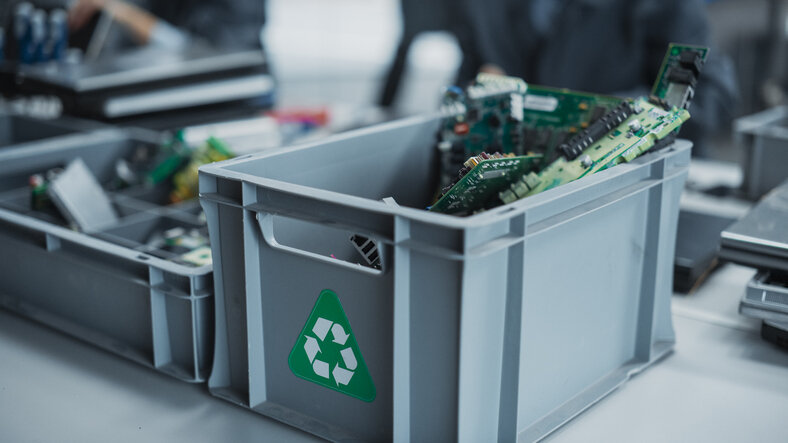
The E-waste Collection & Recycling Association reports that U.S. consumers generate 6.9 million tons of e-waste annually. Yet only a fraction of this byproduct is properly recycled, and the rest is disposed of in landfills.
Understandably, the professional market is a large contributor to this number. Being environmentally responsible is one part of the equation. But security risks, especially for businesses with sensitive internal and consumer data, are another significant concern. Therefore, it is important for companies to understand their e-waste generation and have a plan in place to properly dispose of it.
There are legal parameters that must be followed regarding e-waste disposal to ensure compliance. Currently, there is no specific federal regulation on e-waste disposal. However, many states, including Indiana, have enacted their own legislation dealing with the issue. Indiana’s electronic waste law, IC 13-20.5, prohibits small businesses from disposing of e-waste in the trash and establishes guidelines for manufacturers of electronic devices as well as e-waste disposal facilities. Although there is no specific federal legislation pertaining to all e-waste, the Resource Conservation and Recovery Act (RCRA), which regulates the disposal of hazardous waste, does come into play when e-waste contains certain hazardous chemicals, mainly mercury or lead. Organizations, regardless of their size, can fall under the RCRA if they handle or produce waste containing these or other hazardous compounds.
What is E-Waste?
E-waste is defined by the Indiana Department of Environmental Management (IDEM) as “any waste that is or has a circuit board, electronic component (e.g., diode, resistor, capacitor, or coil), display device, or computer. It does not include vehicles or white goods like refrigerators, ranges, water heaters, or other similar large appliances.” IDEM’s website goes on further to explain that “e-waste contains heavy metals—such as lead, mercury, cadmium, and hexavalent chromium—that can be harmful if released into the environment.”
Developing a Disposal Plan
Regardless of whether a business is a producer of e-waste through its production process or office space that relies on computers and other devices, it is important to have a disposal plan in place in order to ensure compliance with regulations – and keep sensitive data secure.
The first step in a comprehensive e-waste disposal plan is to identify the sources within an organization where e-waste is produced. These can include byproducts of production processes, outdated office supplies, and even wear parts and power sources such as batteries. Once these sources are identified, the next step involves collection. One crucial part of the collection step is ensuring that if a business produces e-waste categorized as hazardous, it is handled, stored, and turned over to the proper disposal organizations. More information on the specifics of hazardous waste defined by the RCRA can be found on the Environmental Protection Agency website.
Once collection is complete and a schedule is established to ensure proper collection continues in the future, consideration must be given towards information security. E-waste includes computers used to conduct business, and even though hard drives can be wiped, it is recommended that employers ensure they are removed and destroyed prior to disposal. Even a severely outdated computer can pose a data breach threat, as explained by the information security experts at Shred-it: “No matter how old or broken-down computer hardware is, data files remain intact, and software exists that can recover them. That’s why it’s important to remove and securely destroy the hard drive before tossing, donating, or recycling equipment.” IT department personnel can be trained for this task, and it is crucial that multiple controls are put into place to ensure a company’s data does not make it into the wrong hands.
The final step in an effective disposal plan ensures companies document and report the disposal process. This report will include how much e-waste was disposed of, measured in LBS, what registered disposal company was used, and a future estimation of e-waste generation based on the organization’s specific circumstances. Hoosier businesses have the option to participate in IDEM’s E-Cycle program, which includes an annual online report of e-waste disposals.


